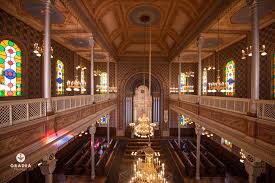
The Great Synagogue of Oradea / Sinagoga Mare Ortodoxă
Save this spot to your dashboard, build trip lists, and get notified when new local guides recommend nearby places.
The Great Synagogue was a major center for Oradea's large Jewish population, which was a third of the city by the early 20th century, representing Jewish integration and modern religious practices.
Prior to World War II, the Jewish community in Oradea was significant, contributing to finance, industry, and culture, with 27 synagogues historically.
The design is Oriental/Moorish Revival, a popular style for Neolog synagogues in the late 19th century, featuring a large dome and U-shaped women's gallery. The synagogue was built in 1890 by the engineer Ference Knápp based on the plans of the architect Nándor Bach. The edifice has an eclectic style with Moorish decorations. It is built on a rectangular plan, with the main facade being more richly decorated than the rest of the building. The central entrance is flanked on both sides by stained glass windows finished in a circular arch.
Today, the Great Synagogue is an active synagogue, though the local community is small, and it stands as a major landmark, often restored and used for cultural tourism, with memorials to Holocaust victims.
The synagogue is open on Tuesdays through Fridays from 8 AM to 4 PM; it is closed on Saturdays, Sundays, and Mondays.
A black marble monument commemorating the more than 30,000 local Jewish victims of the Holocaust stands in the courtyard.
Visitors are generally required to present a passport and may be asked for a donation to enter.
Community Photos
No photos yet. Be the first to contribute!
Great for:
City
The Great Synagogue of Oradea / Sinagoga Mare Ortodoxă
Historic SiteThe Great Synagogue of Oradea (now in Romania, historically Hungary) is a prominent, large Neolog (Reform) synagogue built in 1878, known for its distinctive Oriental/Moorish style, reflecting the modernity and integration aspirations of the large Jewish community there before WWII, and it serves as a significant cultural heritage site despite being an active, albeit small, congregation today, often needing tourist help for prayer services. The Great Synagogue was a major center for Oradea's large Jewish population, which was a third of the city by the early 20th century, representing Jewish integration and modern religious practices. Prior to World War II, the Jewish community in Oradea was significant, contributing to finance, industry, and culture, with 27 synagogues historically. The design is Oriental/Moorish Revival, a popular style for Neolog synagogues in the late 19th century, featuring a large dome and U-shaped women's gallery. The synagogue was built in 1890 by the engineer Ference Knápp based on the plans of the architect Nándor Bach. The edifice has an eclectic style with Moorish decorations. It is built on a rectangular plan, with the main facade being more richly decorated than the rest of the building. The central entrance is flanked on both sides by stained glass windows finished in a circular arch. Today, the Great Synagogue is an active synagogue, though the local community is small, and it stands as a major landmark, often restored and used for cultural tourism, with memorials to Holocaust victims. The synagogue is open on Tuesdays through Fridays from 8 AM to 4 PM; it is closed on Saturdays, Sundays, and Mondays. A black marble monument commemorating the more than 30,000 local Jewish victims of the Holocaust stands in the courtyard. Visitors are generally required to present a passport and may be asked for a donation to enter.
Submitted by LR · Jan 10, 2026