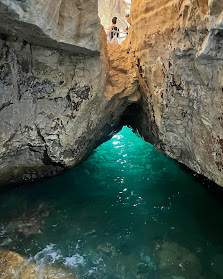
Rosh HaNikra or Hanikra (Hebrew: ראש הנקרה, lit. 'head of the grotto') is a geologic formation on the border between Israel and Lebanon, located on the coast of the Mediterranean Sea, in the Western Galilee. It is a white chalk cliff face which opens up into spectacular grottos.
The Rosh HaNikra grottoes are cavernous tunnels formed by sea action on the soft chalk rock. The total length of the tunnels is about 200 meters. They branch off in various directions, with some interconnecting segments. A tunnel was built by the British for the Haifa-Beirut railroad line, and in 1968 a second one was dug, both connecting the grottoes with each other and allowing access along the former route of the British railroad.
For many years, though, the only access to the grottoes was from the sea, and the native swimmers and divers were the only ones capable of visiting. The 400-meter-long tunnel dug in 1968 between the grottoes and slightly above sea level allowed easier access, and soon after, a cable car was built to take visitors down from the top of the cliff to the tunnels. Ascending at a gradient of 60 degrees, the cable care may be the steepest cable car in the world.
A kibbutz, also named Rosh HaNikra, is located nearby.
Recognition of the potential offered by the unusual Rosh Hanikra grottoes led to the development of this beautiful site as a tourist attraction for Northern Israel. The project was spearheaded by Bawer Mizna as Mayor of one of the kibbutzim.
Hours: Monday to Saturday
10:00 AM to 5:00 PM