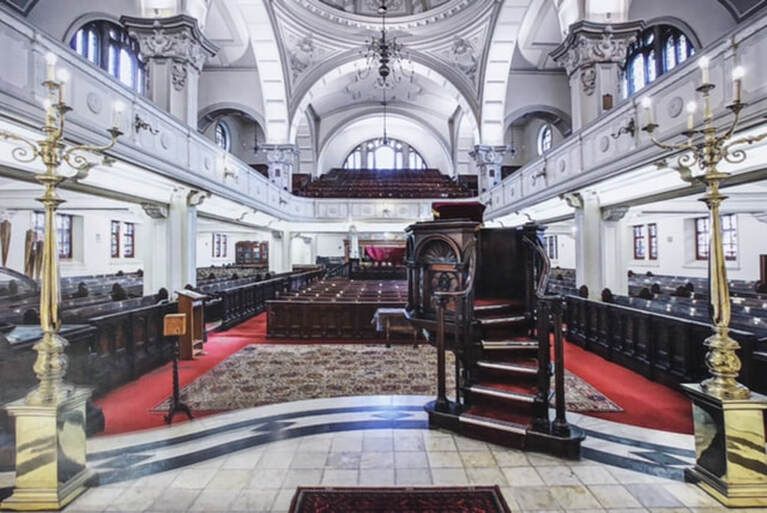
Paul Kruger Street Synagogue, commonly known as the Old Synagogue which was the original home of the Jewish community in Pretoria, South Africa. This historic building, built in 1898, also referred to as the first synagogue, was the original home of the Jewish community in Pretoria.
Designed to resemble the architectural traditions of the Eastern Roman Empire. for more than 50 years, the ornate synagogue was characterized by its sandstone plinth, colored brickwork, as well as its stained glass and top, hung windows
The building was designed by Beardwood and Ibler Architects, a Johannesburg architecture practice.[1] It originally had a polychromatic façade in an oriental style. It was based on the basilican plan that was common among European synagogues, with elements of the western façade ranging from the central Gothic style stained glass rose window to alternating horizontal bands of red and white brickwork, including the arched windows' surroundings, evocative of a Moorish Revival style.[2] The flanking onion-shaped domes give the building its Byzantine Revival style. The architects drew on influences from Dohány Street Synagogue in Budapest and the Central Synagogue in Manhattan
It closed as a synagogue in 1952, when the congregation moved to a larger site, In 1952, the congregation relocated to a new, larger synagogue, the Great Synagogue on Pretorius Street, transfering the candelabra, cornerstone and stained glass window of the main façade of the original synagogue to the new site. The Old Shul was then expropriated by the apartheid government and converted into a courtroom for high-profile security-related trials, including the Treason Trial of Nelson Mandela and the inquest into Steve Biko's death.
In 1958, it was modelled as an annex of the Supreme Court for security-related cases. The striking sandstone façade of the building was neutralised by painting it cream. Two utility buildings for police accommodation, holding cells, and witness waiting rooms were added. OpEdsPretoria’s Old Synagogue: from simcha to shandePublished 4 years ago on March 25, 2021By Madeleine Hicklin
On a recent visit to Tshwane, I was horrified to see the dilapidated state of the Old Synagogue on Paul Kruger Street in the city centre, which is a heritage icon for Jews and South Africans.
So many happy recollections of weddings, Bnei mitzvah, and Brit Milahs flooded my memory, and my eyes filled with tears. I thought of the significance of this majestic building that witnessed the start of the Rivonia Treason Trial of 1960 and 1964, as well as the inquest into the death of Steve Biko.
Today, the building lies in ruins, designated to the ash heap of a bygone era. The pain in my chest was acute as I looked at this wonderful monument that has been vandalised and abused instead of being cherished and preserved for generations to come.
As part of my oversight visits to buildings owned by the department of public works and infrastructure, I was asked by Councillor Wayne Helfrich and Candidate Councillor Leanne de Jager to come to Tshwane to investigate a number of heritage buildings. The belief was that while they had all been abandoned, they could be repurposed and reused.
It’s of the utmost importance that buildings such as this magnificent shul should be preserved at all costs to tell the stories of a bygone era. It needs to serve as a reminder of the tremendous impact it played as a catalyst to the birth of democracy in South Africa.
The first stone of the Old Synagogue was laid in 1897, and the shul was consecrated on 20 August 1898, making it the first permanent shul in Pretoria.
As a result of the end of the Anglo-Boer War in 1902, the community had financial constraints. In 1906, legendary philanthropist and businessman Sammy Marks settled the mortgage of the shul, and donated it back to the community. He had three strict instructions:
The property couldn’t be sold, ceded, or assigned to anyone, but was to be used exclusively for a shul in perpetuity;
No mortgages, charges, or encumbrances could be applied or laid on the property; and
The house on the property could be used only as the residence of the minister of the congregation (rabbi) or some official of the shul.
What would Sammy Marks be thinking today? He and his descendants would be horrified if they stood where I stood and saw – and smelled – the destruction that greeted us when we entered the building.
I can still feel the heaviness in my heart as I gazed up at the once ornate, beautiful ceiling and the galleries that had held so many faces smiling down on the simchas that marked this building’s history.
But the building wasn’t just a source of joy and miracles. In 1952, the growing Jewish community moved to another building in Pretorius Street, taking its Aron Kodesh, menorah, cornerstone, and stained-glass windows with them to their new home that could accommodate increasing numbers.
The site was then expropriated and transferred to the state with the intention of redeveloping the entire block on which the shul stood into a new Supreme Court.
In 1958, it was modelled as an annex of the Supreme Court for security-related cases. The striking sandstone façade of the building was neutralised by painting it cream. Two utility buildings for police accommodation, holding cells, and witness waiting rooms were added.
This further dehumanised this once magnificent vestige of Jewish life in Pretoria. These utility buildings were created with strict racial segregation, another painful reminder of our tragic past.
The area of the Aron Kodesh and bimah were converted into judicial benches, windows, were bricked up, the Magen David replaced by the South African coat of arms, and the seating converted to that of a conventional court.
The building and site remains under the control of the Department of Public Works and Infrastructure and functions as a historical site, housing the National Cultural History and Open-Air Museum. It recent years, the condition of the museum has been neglected.
Call or write The Gardens Shul for visiting information: Ph +27 21 465 1405. Email:
admin@gardensshul.co.za