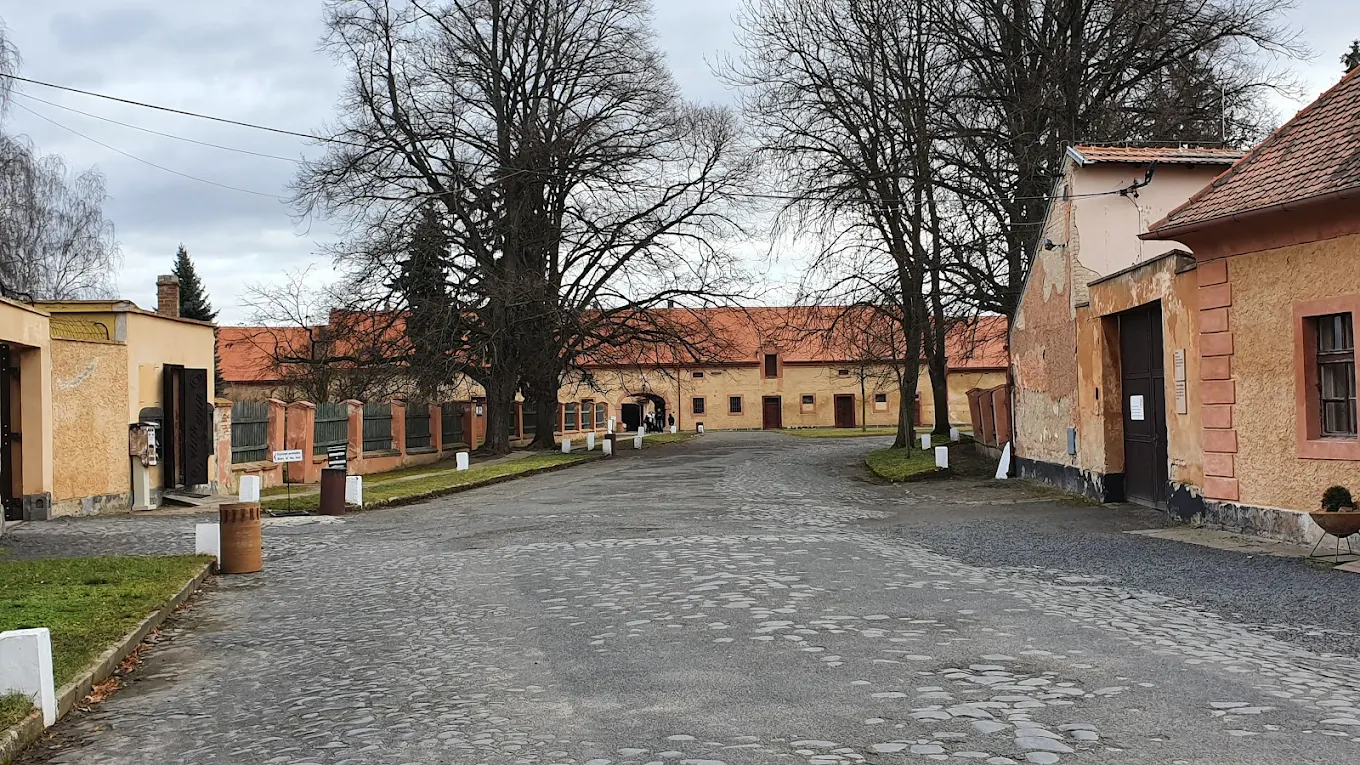
Theresienstadt Concentration Camp
Free
Create a traveler profile to unlock more
Save this spot to your dashboard, build trip lists, and get notified when new local guides recommend nearby places.
Historic Site
Museum
Theresienstadt Concentration Camp, known as Terezín in Czech, was a unique Nazi camp established primarily for elderly Jews, disabled World War I veterans, and notable artists and intellectuals. It served as a transit point and a façade for the Nazis, misleadingly presented as a "retirement community" to appease humanitarian concerns while masking the cruel realities of the Holocaust.
Theresienstadt ghetto and concentration camp were located in Terezín, Czech Republic, in a former military fortress. Initially, it was established as a ghetto for Czech Jews. Later, it served as a concentration and transit camp for German and Western European Jews.
In 1942, SS authorities deported Jews to concentration camps, forced-labor camps, and killing centers. In the camp itself, thousands of people died from disease or starvation.
In 1944 the Nazis temporarily beautified Theresienstadt to deceive an investigating committee from the International Red Cross to make a film that pictured the ghetto as a 'spa town' where elderly German Jews could retire. The barracks were removed, houses were painted, and gardens planted, however, this was an elaborate hoax. The Nazis staged social and cultural events for the visitors. The facts were very different. Of the approximately 140,000 Jews transferred to Theresienstadt, 33,000 died, and 90,000 were deported; only about 19,000 survived. Children were sent to Theresienstadt. About 15,000 children passed through, and 90 percent of these children perished in the killing center.
One can readily find lists of the artists, musicians, playwrights, and writers who inhabited the camp-ghetto. Their collective output was marvelous. The camp was home to an amateur theater group, incidentally headed by Shakespeare’s German translator, Eric Saudek. Professional pianist Gideon Kline arranged Czech, Polish, Russian, and Hebrew folksongs, inspiring rehearsed choral performances. The children’s opera Brundibár, a fairy tale about family love and severe deprivation by prisoner Hans Krása, was staged fifty-five times. And over 2,300 public lectures were delivered. One prisoner was the rabbi-theologian Leo Baeck who was deported to Theresienstadt with his family in 1943. Leo Baeck left Theresienstadt as a 72-year-old survivor—with a manuscript in progress.
A museum was erected there by the Czech Republic in 1989.
Hours:
Summer time: from 9 a.m. to 5 p.m.
Winter time: from 9 a.m. to 4 p.m
Theresienstadt ghetto and concentration camp were located in Terezín, Czech Republic, in a former military fortress. Initially, it was established as a ghetto for Czech Jews. Later, it served as a concentration and transit camp for German and Western European Jews.
In 1942, SS authorities deported Jews to concentration camps, forced-labor camps, and killing centers. In the camp itself, thousands of people died from disease or starvation.
In 1944 the Nazis temporarily beautified Theresienstadt to deceive an investigating committee from the International Red Cross to make a film that pictured the ghetto as a 'spa town' where elderly German Jews could retire. The barracks were removed, houses were painted, and gardens planted, however, this was an elaborate hoax. The Nazis staged social and cultural events for the visitors. The facts were very different. Of the approximately 140,000 Jews transferred to Theresienstadt, 33,000 died, and 90,000 were deported; only about 19,000 survived. Children were sent to Theresienstadt. About 15,000 children passed through, and 90 percent of these children perished in the killing center.
One can readily find lists of the artists, musicians, playwrights, and writers who inhabited the camp-ghetto. Their collective output was marvelous. The camp was home to an amateur theater group, incidentally headed by Shakespeare’s German translator, Eric Saudek. Professional pianist Gideon Kline arranged Czech, Polish, Russian, and Hebrew folksongs, inspiring rehearsed choral performances. The children’s opera Brundibár, a fairy tale about family love and severe deprivation by prisoner Hans Krása, was staged fifty-five times. And over 2,300 public lectures were delivered. One prisoner was the rabbi-theologian Leo Baeck who was deported to Theresienstadt with his family in 1943. Leo Baeck left Theresienstadt as a 72-year-old survivor—with a manuscript in progress.
A museum was erected there by the Czech Republic in 1989.
Hours:
Summer time: from 9 a.m. to 5 p.m.
Winter time: from 9 a.m. to 4 p.m
Address
Principova alej 304, 411 55 Terezín, Czechia
Contact
Ph: (+420) 416 782 225 Email: pamatnik@pamatnik-terezin.cz
Own this place?
Submitted by
LR
on Sep 1, 2025
Community Photos
No photos yet. Be the first to contribute!